
|
Education is an internal process thanks to which children progressively get their whole development in all the maduratives areas of human beings. Friedrich Fröbel said: "Education is the mean that leads humans, as intelligent, rational and conscious people they are, to practice, develop and show the elements of the life that they own by themselves". Taking into account the previous considerations the article number 21 from the Convention about Children's Rights, approved by the ONU in November, 1989, says:
Although it is not a strict definition this article defines perfectly what we currently have to understand as education. Nowadays we could define education as something that is offered to every children in order that they can acquire conscience of their creative and sensory motor capacities, of their expression and communication capacities and finally, of their intellectual and emotional abilities, all through pedagogic and recreational experiences. Dr. Delors wrote an essay for the UNESCO; according to it, the 21st century education should be based on the following props:
Dr. Delors affirms that education has two missions: to teach children about the diversity of the human species and to contribute to make children aware of the similarities and dependence amongst all human beings. In this way schools have to take advantage of as many opportunities as possible to carry out these two types of education, from the early childhood. It is evident that we have to help children through education. We will help them to become free people; to be free they have to learn how to be critical and how to offer the best from themselves to the society. They will also be helped to form their personality and to learn how to live; in this way children will have internalised different moral and social values. Education promotes the possibilities that Nature, the heritage or the environment offer the children. It never tries to change children according to a static model; on the contrary, education tries to stimulate the best things each child owns. Thanks to education we can form new generations; these generations will know and understand the world and compromise themselves to improve that world little by little. Education has to be adapted to the new challenges and opportunities of the modern society, in which many changes take place. Scientific, humanistic and artistic knowledge, as well as the ones about the different cultures, will help us to adapt education to all these new necessities. Without any doubt, education is more than the mere acquisition of knowledge; in this way it would never have to be confused with instruction. Thus, education takes into account not only the things that can be learnt in the schools, but also the ones that are learnt from the family, some friends, the environments, the mass-media, etc.
The Society Today If we are going to educate a child to live inside a specific society, first of all we will have to reflect on the kind of society in which that child is going to develop and its rules, guide lines and values. In order to get an approximate idea about how the society will be in the future, we have to study the current cultures and the changes that are taking place inside them, as far as customs, rules and social relationships are concerned. Above all, it is very important to observe the problems and their causes; in this way we will promote a kind of education that improves our present society. Some important facts: 20% of the worldwide population enjoys most of the planet goods. Most women in the world are in an inferior situation in relation to men; more than 10 million children don't receive any kind of education and other 100 million will never finish their primary studies. There are about 800 million of illiterate people in the world; most of them are extremely poor and are subjected to any type of exploitation. These people live in the poor suburbs of what we call developed countries and in many places of Africa, Asia and South America; in those places million of children die each year because of illness, malnutrition and violence. There is a clear difference in the distribution of the goods of our planet. In the most developed countries a big amount of people has received superior education, and most of them own PC´s with which they can surf the web, interactive TV´s, phones and other technological advances that give them the access to culture and knowledge. The areas that own material resources enjoy scientific progress and, as a consequence of this, they also enjoy democratic societies with more freedom and dynamism. There is a very spread tendency in these communities: people consume too much and they compete each other all the time; everybody, even the children, suffers from stress. Bad eating habits and the consumption of alcohol, tobacco and others drugs have provoked an increase in the number of illnesses. We can find emotional problems, as well as depression and anxiety everywhere. People commit suicide more often than some years ago. The quality and the number of hours that parents spend with their children have decreased; at the same time, they offer the children more and more material goods. This is one of the main family problems according to what sociologists think. But these developed countries are also suffering from other things: violence in the streets, racism, xenophobia, drug addiction, drug traffic, immigration, the deterioration of the environment and a huge etc. The differences between poor and rich countries are threatening the planet balance, because the richest a country is, the most things its inhabitants want to have; meanwhile the inhabitants of poor countries become even more frustrated, disappointed, downhearted and impotent. Everybody should be conscious of the damage we are causing to our planet: all the conflicts in any part of the world affect the entire world; for example, a war or famine in a specific area provoke massive migrations towards "luckier" countries. These population movements only make worse the problems mentioned before. We have another example in the stock exchange of NY and Tokyo: they destabilise the economy of most of the countries in our planet. We can find the solution for serious problems of the present days in EDUCATION, and we, the teaching staff, are responsible of this education. As a oriental proverb says: "If you want prosperity for a year, plant some rice, if you want prosperity for ten years, then plant some trees. But if you really want prosperity for a whole life, give education to the new generations".
Education in values Each child is a unique, and original human being, the most perfect and beautiful product of Nature. That individual, because of the influences of his/her environment, becomes a product of the culture in which he/she grows up. In our civilised world, especially in the cities, the development of a child is completely different from what Nature arranged. The satisfaction of his/her existence depends either on his/her personality or on the environment in which that child lives, that environment should be favourable, so that the security and satisfaction of the child are not threatened. The education we give each child must respect his/her personal characteristics, but we don't have to forget that a child doesn't live isolated, but in a society. This child will evolve according to the quality of the human relationships he/she establishes. Children are sociable beings since they are born. As they grow up they are able to assume responsibilities, as members of the society they are in; they can also contribute their originality. When a child is born he/she doesn't know anything about rules or moral and social values; in this way, educators become a mean that facilitates for him/her the experiences and relationships he/she needs to get his/her progressive social maturity. We can define a value as a real, desirable and objective element, which is convenient for all human beings. People internalise it through individual experiences and then it becomes a moral conduct rule for them. Each person, according to his/her experiences selects and chooses a value system that helps him/her to develop a moral conscience; if that person practices these values he/she will acquire what we call an individual commitment. Education, as we have mentioned before, promotes the internal maturity a child needs to acquire an autonomous moral consciousness. In the first stages of their growth, children start to know themselves, as well as people around them and the ambience in which they develop, or what is the same: they are educated influenced by the environment. This should offer them positive rules and values. It is very positive to remember the second article from "Universal Declaration of Human Rights" (10-12-1948):
Qualities, Internal Resources and Values Sometimes the qualities, the internal resources and the values are the same thing. The characteristics and the internal resources can be innate and sometimes they become social and moral values. The important thing is not knowing how to distinguish them. What is necessary is that they provide the basic ingredients to develop children potentials in all human dimensions. Some qualities are innate in people since we are just born, and according to our childhood, they will become either internal resources or values, or they will be spoiled forever. It is very important to recognise and appreciate these qualities, because not all the children have them. If they do, educators have to help them to use and develop such qualities. People usually don't have all the qualities, but they have most of them. Some of them are related to each other, so if there's a problem in any of them, the rest of the qualities will also be affected. Some qualities, internal resources, virtues and values
It is impossible to analyse all the qualities, virtues and values in this essay; apart from the ones mentioned before, we can add: appreciation, confidence, efficiency, independence, justice, liberty, maturity, modesty, mercy, respect, responsibility, naturalness, tolerance, tenderness, willpower, authenticity, charity, cordiality, dialogue, warmth, dignity, effort, hope, discipline, familiarity, happiness, illusion, gratitude, honesty, naturality, obedience, work, originality, availability, sweetness, firmness, resolution, humanity, sincerity, cooperation, love, citizenship, philanthropy, unity etc.
Early education in values It is evident that education is, above all, an internal trip, with stages that correspond with the stages of personal maturity. This maturity will provide knowledge and attitudes to children; from then on they will base their behaviour and actions on them. It is also very important to learn how to live together. To get this aim children should be taught the rules this coexistence follows from the early stages in their lives. If we understand Early Education as "the education that develops children's personality, abilities and mental capacities up to the maximum", we can also affirm that this education develops the personality and the values that make the coexistence possible up to the maximum. The fundamental achievements of the development of personality are the formation of self-conscience and an undoubted subordination of motives. Thanks to these things children acquire a stable internal world that allows them to participate actively in their environment and gives a determinate tendency to their whole conduct. The main condition to be able to speak about the formation of personality in this age is that children's behaviour can be foreseen. The important point of this formation is the observance of socially accepted conduct rules that children assimilate to their activity and their relationship with the adults and their environment. These rules regulate their conduct in a more effective way than in posterior stages. From this point of view values are formed during the development process of an individual, from its early stages. In this way, values are infinite, in the sense that the objective and ideal reality is infinite, too. This bases the values formation. The starting points of the specific values that are going to define an adult human being are set up according to the "children global approach" (although we don't try to speak about specific values in such young ages).To elaborate this values educational program we have taken into account that it is adaptable to any culture or community. It is easy to carry it out; it offers a positive model of roles and transmits fundamental virtues and qualities. The values formation in early childhood has to be developed in the same way that habits, abilities, knowledge and capacities are; so the same educational processes and procedures will be used: They will be taught in a global way. We have only chosen some universally accepted values and they are treated in amplitude and depth. Educators will be able to develop some others that are important in their culture from these ones. Values, as rules, notions, capacities, abilities and other psychologist formations, are treated from a global approach in the first years of life. Only at the end of the pre-scholar age these global values start to be differentiated, as the development of the children allows them living more intensively the reality around them. We have considered the global approach through the following values:
We pretend to offer the children the opportunity to elaborate and look for some knowledge and we want them to appreciate the importance and value of these pieces of knowledge, as well as their use in the daily life. A program for children can't be uniform, so we have chosen activities that by mean of easy strategies can be adapted to the necessities of the group (or a specific child) is carrying it out. Children are the protagonists of this program; it is only thought to be a mean thanks to which children will apprehend social and moral values. Games are one of the main activities for the development of children; thanks to them children learn the most important relationships of the real life. So the values formation has to be carried out only through games, although the final phase of the process (the one that culminates a determinate acquisition level) uses another means to set up the new knowledge. Values are not taught as values, but they are a consequence of some interesting activities for the children. With these activities children will work in the composition of the future values. When a child, acting as a "hero" helps a destitute friend in a role play the facts that are being produced have an influence on the conception of what friendship and solidarity are; as this activity is being repeated those things of friendship and solidarity become a personality value. Values are known, learnt and chosen through daily life actions, thanks to the pieces of knowledge children assimilate by themselves and to the ones they observe from adults, this can happen either in a spontaneous way or in a planned one. When educators plan to "teach" a value the final result will be that the individual value coincides with the social value or rule. Perhaps this wouldn't take place if values were only learnt in an spontaneous way. The formation of habits and the practice of different activities that are taught to develop values in children have to provide them feelings and experiences (and not only outer reinforcements) to orientate their conduct. In this sense it is easy to understand that pieces of knowledge by themselves don't guarantee the value formation, so they will always have to be accompanied with emotional experiences. Because of all the previous reasons we can affirm the activities intended to work on values must be rich and stimulating ones and they have to provide positive emotional experiences to children. They constitute the ideal educational way to reach a truthful value formation that will regulate children's behaviour even in those situations in which they hadn't been prepared to face the problems. Taking into account the age of the children and being aware that children will only work on things they like or interest them, we have provide a setting for this value formation in what we have called "Club of the Children who Take Care of the Planet", because at these ages children are very interested in Nature and they answer favourable and easily to its stimulus.
Why environmental education? Our world is a whole, diversity and a unit. It is a whole because it encompasses all existing natural phenomenon and ideals that are expressed in an extraordinary diversity of facts, objects and individuals, sometimes very different between themselves. However, among all of them there is a unity and each fact or phenomenon of reality is intrinsically linked with the rest and the variation or change in one of them determines a change in the system that may be hard to perceive initially but that can slowly reach a tremendous dimension. This viewpoint of Development marks the totality, diversity and unity of our world, so that each action that takes place in it, whatever the area it happens, be it physical, chemical, biological, psychological or social, to name a few, exerts an influenced over the others, changing and transforming them. Whenever the action is positive, it will warrant an appropriate development and when it is negative, it will have a negative impact. Mankind is the major and most important totality, diversity and unit of the universe. As an organism it is a bio-psycho-social unit; its surrounding environment is the source of its development; at the same time that mankind is the product of that environment it is the only species capable of transforming it. This potential of modifying the environment is a unique feature of human beings. This makes it crucial to know the environment, its forces and laws, peculiarities and conditions. Man, despite this, sometimes acts as if he didn't know this scientific fact and exploits his surroundings without understanding the full impact of his exploitation, with consequences, among others, such as a larger hole in the ozone layer, indiscriminate use of forests, further desertification of the earth and salinization of the waters, a global warming of the atmosphere and an increased rising of the sea levels that endangers the small coastal countries. This is why knowing our environment and acting intelligently to preserve it become fundamental tasks at the beginning of the millennium.
Environmental education as a need for development A way to prevent the further deterioration of the world is to ensure that every person receives appropriate environmental education and acts accordingly to its guidelines. This then becomes a developmental need and an essential educational task. Environmental education encompasses three fundamental aspects:
Environmental education for children from 2 to 6 years old The early education program has the environmental education as one of the main aims, because these pieces of knowledge are very important for the development and even for the survival of human beings. We have to teach this environmental knowledge through a lot of different contents, so we have tried to include most of them in our program. Through them children will learn appropriate pieces of knowledge about environment, ways of action to preserve the natural world and rules and values about its preservation. In this way children will learn about facts of animate and inanimate Nature; the functions of our organism; the relationship between the environment and the health and nutrition; the continuous circle of life, etc. Thus, for example, when a child learns about how a plant grows up from a seed and he/she observes it in practice, as well as the light, heat and humidity conditions that act on it, and then that child is also acquiring conscience about the natural world rules. Or when this same child discovers how a piece of ice melts into water without trace, he/she is learning about how a life source can be contaminated and discovered then the physic world laws. And if we make him/her aware of the relationship between the form and structure of an animal according to the place in which this animal lives (i.e. polar bear) the child will be learning some principles about the animal world. What is really important and fundamental is that the explanations about facts and phenomenon have to be given over a truthful scientific base, without providing any "magic" or "mystic" answer, or any answer that only has an empirical foundation. But if we teach a child that if we feed an animal it becomes bigger and more healthy; if we teach him/her that watering a plant it becomes more and more beautiful.... and if he/she learns about the relationship between the things he/she knows and the actions he(she carrying out, then that child will be consolidating the apprenticeship about the environment and the actions to preserver it. So it is not enough to teach only the pieces on knowledge, but also how we have to act. This education has to begin when the child is very young; first of all it will consist only on things like "please, don't step on that leaves" or "don't hurt the picture of that animal", but later he/she will be taught more specific pieces of knowledge and ways of acting in the daily life to preserve the environment: The caring of the orchard, the cleaning of the school... Through all the pedagogic and methodological possible ways. This is what makes environmental education a transverse and general program that is developed through all the activities of the school, because those activities are related, in one way or another, to the environmental education knowledge, rules, actions and values. |

 As
any problem can affect everybody we are responsible of promoting the
HUMAN VALUES that promote solidarity, opening and tolerance towards
other races and cultures. We should fight for justice, equality and
freedom of all the countries of our planet. Because all together we
are able to look for solutions that stop the differences between countries
as well as the damage of the environment.
As
any problem can affect everybody we are responsible of promoting the
HUMAN VALUES that promote solidarity, opening and tolerance towards
other races and cultures. We should fight for justice, equality and
freedom of all the countries of our planet. Because all together we
are able to look for solutions that stop the differences between countries
as well as the damage of the environment. It
is impossible to work in a direct way in the value structuration (it
is also impossible when it comes to capacities or motivation). In this
way we will have to develop well-organised activities that allow children
to orientate by themselves while going through them. This orientation
is transferred to another similar activity and so on until the capacity,
motive or value is formed (depending on what we want to establish).
It is a serious mistake thinking about "direct work" when it comes to
value formation; on the contrary, what we have to do is working on abilities,
habits, concepts, notions and experiences that are going to lead to
the formation of a value.
It
is impossible to work in a direct way in the value structuration (it
is also impossible when it comes to capacities or motivation). In this
way we will have to develop well-organised activities that allow children
to orientate by themselves while going through them. This orientation
is transferred to another similar activity and so on until the capacity,
motive or value is formed (depending on what we want to establish).
It is a serious mistake thinking about "direct work" when it comes to
value formation; on the contrary, what we have to do is working on abilities,
habits, concepts, notions and experiences that are going to lead to
the formation of a value. 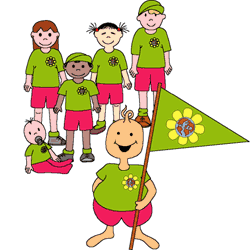 Probably
the most important thing of this program is that emotions and love feelings
towards plants, animals, Nature and the world in general, have to be
consolidated in children. Each child has to learn that the environment
is a gift he/she has received and as a consequence he/she has to love
and preserve it. Only by learning these things is how we can guarantee
an appropriate environmental education.
Probably
the most important thing of this program is that emotions and love feelings
towards plants, animals, Nature and the world in general, have to be
consolidated in children. Each child has to learn that the environment
is a gift he/she has received and as a consequence he/she has to love
and preserve it. Only by learning these things is how we can guarantee
an appropriate environmental education.